
How to grow lichi in SUdnernagar
Category: Agriculture
-

Why apple prices are up 18% this harvest — a mandi breakdown
Apple prices across Shimla district’s mandis are running roughly 18% above last season’s harvest average, according to trader reports from Shimla, Kotgarh and Rohru — the state’s three largest apple markets. Here’s a breakdown of what’s driving it and what growers are seeing on the ground.
What’s pushing prices up
Traders point to two overlapping factors: an uneven flowering season in April that reduced yield in several mid-altitude orchards, and stronger demand from wholesale buyers in Delhi and Chandigarh entering the market earlier than usual this year. Growers in higher-altitude belts around Kotgarh, where flowering was less affected, are reporting comparatively better volumes than the Rohru side.
Current rates
- Shimla mandi: ₹68–82 per kg, grade-dependent
- Kotgarh: ₹72–88 per kg for premium grade
- Rohru: ₹65–78 per kg
Rates vary significantly by grade and box quality — premium controlled-atmosphere storage fruit is fetching the top end of these ranges, while lower-grade fruit sold for immediate processing is well below it.
What growers are saying
Several orchardists in the Kotgarh belt say the higher prices only partly offset a difficult season — hailstorm damage in early summer cut into marketable yield even where flowering held up. The Universal Cartons rate, which growers use as a rough benchmark for packaging costs, has also risen this year, eating into the margin the higher per-kg price would otherwise deliver.
This page will be updated through the harvest season as mandi rates shift — check back rather than relying on a single snapshot if you’re tracking prices closely.
-
Exploring Challenges and Opportunities of Organic Farming in Himachal Pradesh
Challenges:
- Pest and Disease Management: Organic farming relies on natural methods of pest and disease control, which can be challenging in Himachal Pradesh’s diverse climatic conditions. The majority of pests like apple scab and codling moth pose significant threats to organic orchards, requiring innovative pest management strategies.
- Knowledge and Awareness: Despite growing interest in organic farming, it needs widespread awareness and education among farmers regarding organic practices. Many farmers lack access to training and extension services on organic farming techniques, hindering the adoption of sustainable practices.
- Market Access and Certification: Accessing organic markets and obtaining certification can be daunting for small-scale farmers in Himachal Pradesh. The certification process is often expensive and time-consuming, creating barriers for farmers to enter organic markets and command premium prices for their produce.
- Infrastructure and Input Availability: Limited access to organic inputs such as biofertilizers and organic seeds poses a significant challenge to organic farmers in Himachal Pradesh. Furthermore, inadequate infrastructure for post-harvest handling and processing hampers the development of organic value chains in the state.
Also Read – https://himachal.blog/apple-farming-and-other-essential-things/Opportunities:
- Agro-Tourism and Direct Marketing: Himachal Pradesh’s picturesque landscapes present opportunities for agro-tourism and direct marketing of organic produce. Farmers can leverage these opportunities to establish direct relationships with consumers, bypassing traditional market intermediaries and maximizing returns.
- Government Support and Initiatives: The government of Himachal Pradesh has launched various schemes and initiatives to promote organic farming in the state. Subsidies, financial incentives, and capacity-building programs have been implemented to support farmers in transitioning to organic agriculture and accessing organic markets.
- Sustainable Livelihoods: Organic farming offers the promise of sustainable livelihoods for farmers in Himachal Pradesh. By adopting organic practices, farmers can improve soil health, conserve water resources, and reduce their reliance on chemical inputs, thereby enhancing the long-term viability of agriculture in the region.
- Collaboration and Networking: Collaborative efforts among farmers, NGOs, research institutions, and government agencies can strengthen the organic farming ecosystem in Himachal Pradesh. Knowledge sharing, capacity building, and collective marketing initiatives can empower organic farmers and foster a supportive environment for sustainable agriculture.
Conclusion:
Organic farming in Himachal Pradesh holds immense potential offering a pathway towards sustainable agriculture, environmental conservation, and rural development. By addressing the challenges and embracing the opportunities inherent in organic farming, the state can pave the way for a thriving organic agriculture sector that benefits both farmers and consumers. Through sincere efforts and collective action, Himachal Pradesh can emerge as a beacon of organic farming excellence in India.
-
Apple Farming and Other Essential Things you Must Know
Apples are primarily consumed fresh, although a small portion of the harvest is used to make jams, juices, canned slices, and confections.
Factors Usually Required for Apple Farming
Apple farming is possible between 1,500 and 2,700 meters above sea level in the Himalayan region. It endures 1,000 to 1,500 hours of chilling or cooling per year.
The ideal temperature range for the apple growth season is between 21 and 24 °C. For optimal growth and production, apple trees require between 100 and 125 cm of regular annual precipitation.
It would also lead to poor fruit quality, improper color, and expansion of fungal development on the fruit surface if there was excessive precipitation near the fruit vegetative phase.
In areas where significant wind speeds are predicted, there are other options than apple cultivation procedures.
Soil Specifications for Apple Farming
Apple farming techniques work best on loamy soils rich in organic matter with pH levels between 5.5 and 6.5. To ensure effective apple growth techniques, the soil used for growing apples must stay waterlogged.
Apple farming requires soil with sufficient drainage and should be clean. Apples grow well in deep loam soil. However, you can also use well-drained clay-loam soils.
Apple trees are negatively impacted in sandy-loam soils by insects, including stem and root borers, and stem diseases like canker and papery bark. However, the gravelly, shallow soils can be rendered appropriate by adding significant amounts of farmyard manure, compost, or leaf mold.
Apple farming works best on soils high in organic matter, have a pH of about 6.5, and have proper drainage.
Apple Farming Techniques for Planting
Two weeks before planting, 60 cm diameter pits are dug. First, good loamy soil and organic matter are buried in the pits. Then, scooping up some soil, you place the soil ball in the center of the pit, preserving the roots.
The remaining space is filled with loose dirt and lightly pressed to seal air spaces. The seedlings are immediately staked and watered. As a result, on average, 80 to 500 plants can be found in an acre of space.
There are four main planting density classifications: low density (less than 120 apple plants per acre). Moderate density (between 120 and 200 apple plants per acre). High density (between 200 and 520 plants per acre) and ultra-high density (more than 520 plants per acre).
Apple plant spacing and planting density per unit area is based on the combination of stem and rootstock varieties.
For good apple fruit production, pollinator species must be cultivated between the primary species. For example, the Horticulture Department advises planting Red Delicious and Golden Delicious as pollinators for establishing Royal Delicious varieties.
The contour approach is typically used on slopes, whereas hexagonal or square estate arrangements are used in valleys. To produce high-quality apples for apple farming, a pollinator ranch of parent species is created in the middle of the parent species.
In October and November, burrow pits with dimensions of 1 m x 1 m x 1 m are prepared for planting. After correctly blending, 50 grams of Malathion dust, 500 grams of Single superphosphate, and 30 to 40 kg of Farm Yard Manure (FYM) are added to each pit.
After thoroughly mixing, 30 to 40 kg of Farm Yard Manure (FYM), 500 grams of Single Superphosphate, and 50 grams of Malathion dust are added to each pit. Apple growing is immediately followed by one irrigation.
You may also read- https://himachal.blog/a-brief-on-agriculture-and-farming-subsidies-in-india/
Irrigation
Low soil moisture can be particularly damaging to apple trees. The number and size of fruits are decreased, and the June drop is increased when there is water stress during the growing season. In the event of dry spells during the key moment, supplemental irrigation should be offered. The viability of the apple crop largely depends on the even distribution of rain throughout the year.
Poor seed yield, excessive fruit drop, low output, and poor quality are all effects of water deficit.
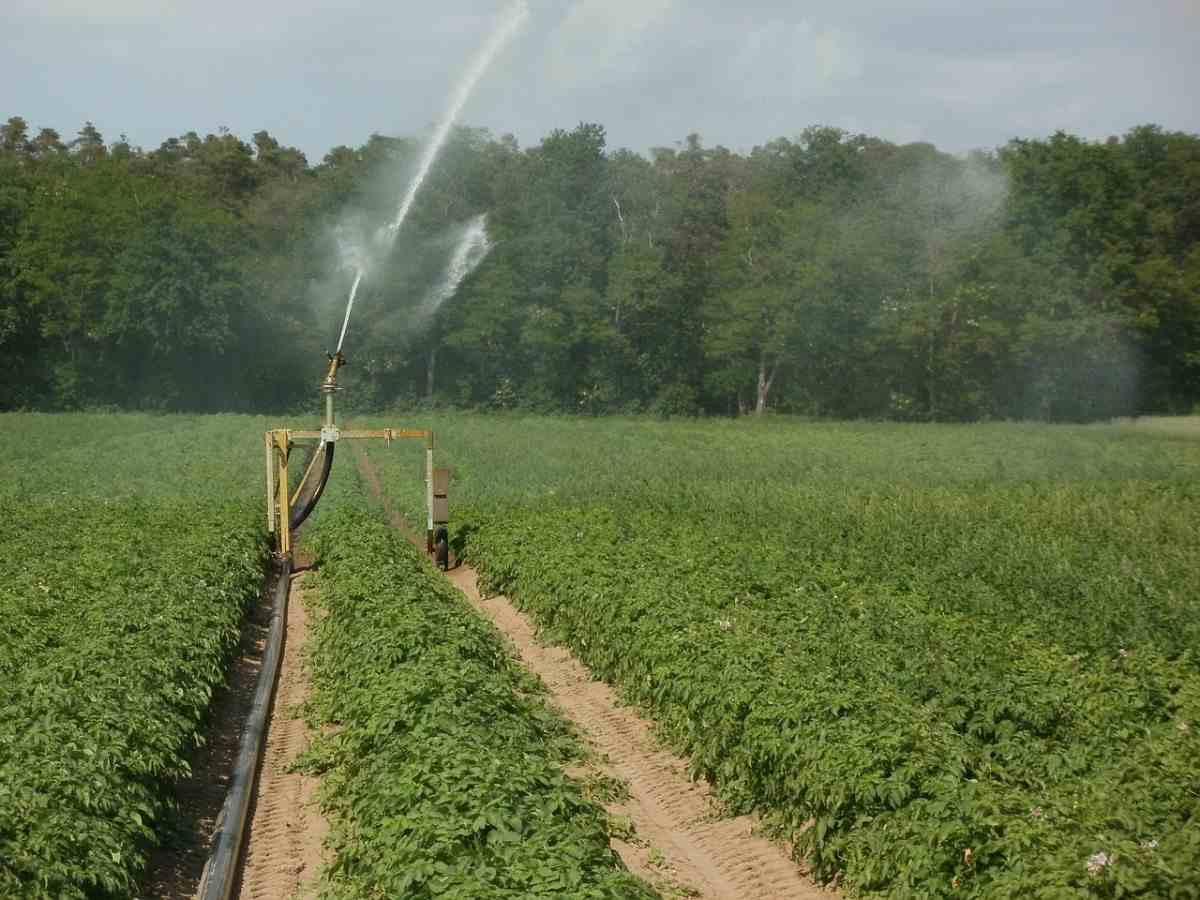
The months of April through August have the highest water demand. Apple farming requires about 115 cm of water per year, which should be scheduled for 14 to 20 irrigations.
In the summer, watering should be sprayed every six to ten days, while in the winter, it should be sprayed every month or so.
At least eight irrigations are anticipated during the key season, which runs from April to August.